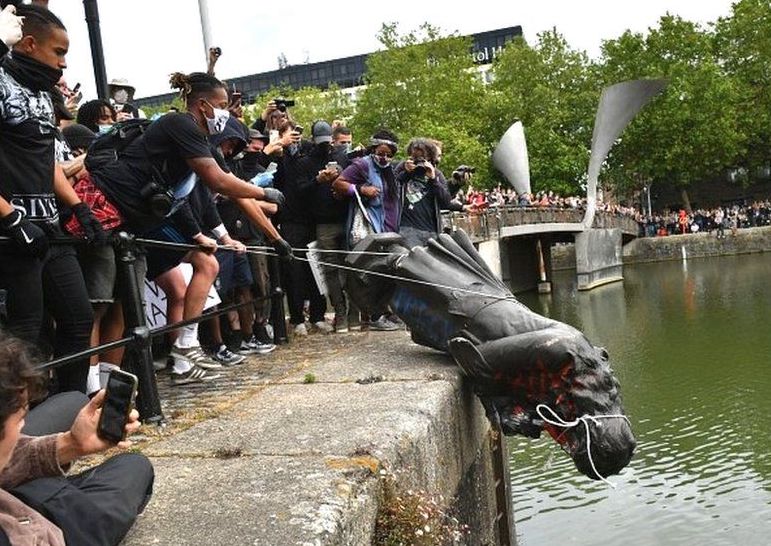
In July 2020, Bristol residents were treated to the sight of Edward Colston’s statue being dragged from its plinth and pitched into the Avon. For long regarded as one of the fathers of the city and a major philanthropist, his activities in the slave trade had made him persona non grata with anti-racism activists.
A plaque detailing his life was produced in 2019 in an effort to balance the record, but never installed. The statue was often covered in graffiti and became the focus of protests in the Black Lives Matter movement. A year later it was gone. At the same time, following similar complaints, the Mayor of London, Sadiq Khan, called for London statues and street names with links to slavery to be removed or renamed.
In Australia, statues of Captain James Cook, the navigator who charted the east coast and claimed possession for Great Britain of parts of New South Wales, are also subject to vandalism by Indigenous activists who regard him as having initiated the European settlement of Australia. There have been calls for his statues in both Australia and the UK, especially that in Sydney’s Domain, to be removed, and for his name to be erased from various streets and parks.
Calls for statues to be removed have become popular, with increasing fervour. But should public monuments be taken down at the behest of any group, or for any reason? These two cases – Colston and Cook – are examples for debate here.
Colston was a major philanthropist. His money came from the slave trade. The proposed plaque summarised his life:
“Edward Colston (1636–1721), MP for Bristol (1710–1713), was one of this city’s greatest benefactors. He supported and endowed schools, almshouses, hospitals and churches in Bristol, London and elsewhere. Many of his charitable foundations continue. This statue was erected in 1895 to commemorate his philanthropy. A significant proportion of Colston’s wealth came from investments in slave trading, sugar and other slave-produced goods. As an official of the Royal African Company from 1680 to 1692, he was also involved in the transportation of approximately 84,000 enslaved African men, women and young children, of whom 19,000 died on voyages from West Africa to the Caribbean and the Americas.”
When the statue was erected in 1895, his philanthropy was the emphasis. The weight has now shifted to where his money came from. There is no doubt at all that he made the money that endowed his numerous charities from the ‘vile trade’. Surely it is obvious that such a man should not be so conspicuously memorialised? What can they have been thinking, in 1895? Or should his philanthropy outweigh, as some would argue, his involvement in producing massive human suffering?
Perhaps. It certainly should not, as again, some would argue, be totally discounted in forming an assessment of Colston’s worthiness. We live in a judgemental era, ever willing to efface the good in a person or institution if they have committed some crime. On that basis, Colston should definitely go.
There is also the argument that in destroying or removing such statues, we are effectively re-writing the past. There is considerable substance in that. By banishing Colston, aren’t we virtually erasing signs of that terrible trade and era? Painting over crimes? The past of any country is chequered with good and bad, glory and horror. Shouldn’t British or Australian history, for instance, be seen in all its colours, not whitewashed into a spurious purity?
But there is another factor that is rarely raised, and which, when considered, makes these protests seem like hypocrisy. Colston was not alone. In fact, the entire city of Bristol was built on the slave trade, almost more than any other city in Britain. It was one of the chief ports internationally that profited from the trade in lives. Slaves were not bought and sold in Bristol; the city grew and made its wealth from building and equipping ships to sail the triangular route from Britain, loaded with trade goods, to Africa, where they were exchanged for men, women and children, who were transported to the Americas, where they were sold to plantation owners, and with the purchase money, rum, sugar, tobacco and cotton were loaded into the now-empty holds to be sold at a profit back home. It was not necessary to captain a slave ship, or own one, to profit: the corner greengrocer could buy a £10 share in a slave ship, while Bristol’s factories were fully occupied with turning out trade goods for Africa, and its warehouses, now fashionable wine bars, were stocked with the cotton and sugar off the returning ships, ready to flood the English market. Every citizen who bought this sugar, cotton or tobacco was a beneficiary of the slave trade, a fact pointed out by the abolitionists. The charming Georgian suburb of Clifton is testament to the money to be made from the Triangle Trade, as are its delightful streets and parks. The city of Bristol, unlike some others with a similar history, has done very little to acknowledge this fact. A tiny plaque on a warehouse acknowledges the grim past. It was installed not by the city, but by the novelist Phillippa Gregory. That is almost all there is. In the end, then, why pick on Colston, when those same activists who threw his effigy into the dock enjoy the facilities he endowed, as do all Bristolians? It is particularisation. Let one man carry the sins of a whole city, or people, and drive him out into the wilderness, and then the rest of us will be clean.
In Australia, James Cook was a naval Lieutenant commissioned by the Admiralty to map parts of the South Seas. He was a man of humble origins who became one of the greatest navigators in the world, responsible for huge additions to the world’s cartographic knowledge, sailing the Pacific on several voyages in his small refurbished collier. In 1770 he mapped the east coast of Australia, penetrating for the first time the Great Barrier Reef and landing in the region of present-day Sydney. Following his voyages, the British government determined to formally colonise the country and from 1788 sent out fleets of ships bearing convicts, militia, livestock, seeds and plants and later, free settlers. This development meant that the land previously occupied for millennia solely by the Aboriginal peoples was progressively taken up by European settlers, with inevitable clashes and massacres of groups of dispossessed locals. The subsequent history included extensive disadvantage of the Indigenous peoples that continues today, although some historic wrongs have been more recently addressed.
This is a very different story from that of Colston. Cook himself spent only a few days in the country, had very little contact with the native inhabitants, and committed no atrocities. His actions were at the behest of his masters and brought him little personal advantage. Why should the statues which recognise the achievements of this naval officer of low status, be the subject of vandalism? Should they, as activists demand, be removed, and all public places named after him re-named? It seems largely symbolic. The real progenitors of the dispossession and distress of the Aboriginal peoples were the British government, led by a series of Prime Minsters. The names of some of these, such as Lord North, whose government sent Cook out in 1770, the Earl of Ripon or Lord Liverpool, are unknown in Australia today. There are few statues to them. Their names are not taught in school history lessons. They are not the subject of the opprobrium which attaches to James Cook. It seems a clear case of shooting the messenger, and again, of particularisation, or, as it would have been called at the time, scapegoating. Perhaps it is symbolic. One man stands for the whole of the colonial project. But in view of the unfairness, in this case, of the selection of one of the greatest navigators of his time, a man who was acting not for his own benefit but on the instructions of his employers, it seems wrong to remove James Cook from his plinth. And, as in Bristol, those who cry for Cook to be pulled down in protest against the European colonisation of Australia enjoy the benefits of that colonisation – the schools and hospitals, roads and trains, the technology and science, in fact the entire panoply of Western civilisation. Can anyone legitimately protest against colonisation while enjoying its fruits?
There is another factor, too, often argued: that the continued public acknowledgement of these reminders of a past whose events now pain us, is a reminder that we are less than perfect, that we get things wrong, that great people have their failings, and people who do dreadful things may also give fortunes to charity. ‘Amazing Grace’ was written by a slave-ship captain who was converted. Today it is one of the most popular of hymns, even among the non-religious. If Colston is to be toppled and Cook erased, shouldn’t this hymn disappear from the song sheets? Don’t we partly love it because of its witness to human frailty and achievement?
It is interesting that those who object to Colston and Cook on their plinths almost universally see destruction or erasure as the answer. A few make an alternative, more creative proposition: that near each of the statues that commemorate someone whose actions led to human suffering, a companion statue could be placed. Next to Colston, a group of Africans in chains; by Cook, an Aboriginal family, gazing out across the land that once was theirs. An educational opportunity for passers-by and a permanent reminder of the costs of trade and exploration, not a vacant plinth that speaks only of destruction and revenge.
 Modern Life