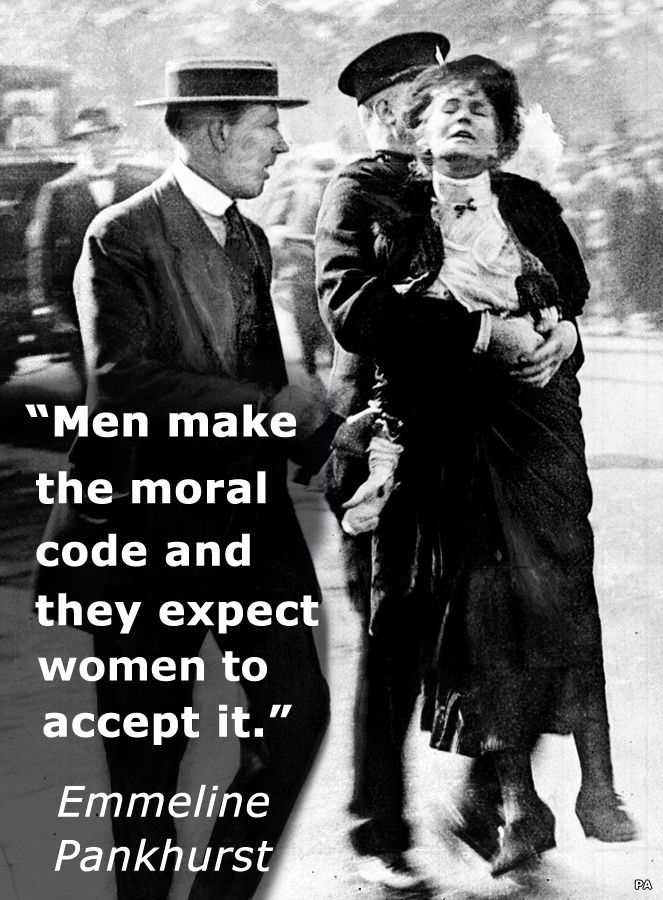
“In 1879 Emmeline Goulden married Richard Marsden Pankhurst, lawyer, friend of John Stuart Mill, and author of the first woman suffrage bill in Great Britain (late 1860s) and of the Married Women’s Property acts (1870, 1882). Britain
Ten years later she founded the Women’s Franchise League, which secured (1894) for married women the right to vote in elections to local offices (not to the House of Commons). From 1895 she held a succession of municipal offices, but her energies were increasingly in demand by the Women’s Social and Political Union, which she founded in 1903 in Manchester.
The union first attracted wide attention on October 13, 1905, when two of its members, Christabel Pankhurst and Annie Kenney, thrown out of a Liberal Party meeting for demanding a statement about votes for women, were arrested in the street for a technical assault on the police and, after refusing to pay fines, were sent to prison.” (Britannica)
Between 1894 and 1908 Australian States progressively enfranchised women. Some British women received rights in 1918 and the remainder in 1928. French and Italian women had to wait until 1944. Switzerland did not grant the right until 1971, and Portugal not until 1976. Saudi Arabian women got the vote in 2015.
Forward to a fictional grand-daughter of Emmeline Pankhurst – call her Sylvie. In the 1960s, as a schoolgirl, she participated in demonstrations in the burgeoning Women’s Liberation Movement. 1975 was declared the International Year of Women, and equal pay for equal work was phased in for the first time in several countries.
In 1977 Sylvie joined the first of the Reclaim the Night marches in the UK. These were:
“Co-ordinated women’s marches against sexual harassment and rape first started in Europe and the USA in the mid-1970s. The first Reclaim the Night march in the UK was in 1977 in Leeds. Inspired by similar marches in West Germany, the Leeds march was partly in response to the ‘Yorkshire Ripper’ murders and the police reaction, which was to tell women they should not go out at night unless absolutely necessary. These early Reclaim the Night marches fought for a woman’s right to walk without fear at night. They made it clear that women should not be restricted or blamed because of men’s violence. In Australia, the first Reclaim the Night marches were held in 1978 in Sydney and Perth. Over the years, although the focus remains on sexual violence, Reclaim the Night has evolved to include other forms of violence against women.” (https://domesticviolenceservice.org.au/a-history-of-reclaim-the-night/)
Jump forward to 2021, in Australia. Sylvie’s daughter – call her Emma – carries on the family tradition by joining a March 4 Justice through the streets of Canberra, the national capital. Mass marches of thousands of women in every State have been sparked by several years of high-profile rape and murder of lone women in the streets, culminating most recently in allegations of rape within the National Parliament buildings of a staff member of the Parliament, which the government attempted to brush off. She brings along her baby daughter – call her Christabel. As she explains to a reporter: “It’s not too young for Christabel to start learning that women have to continually fight for freedom from fear, and for justice. I really hope that by the time she’s grown up, it won’t be necessary any more, and that women will have equal rights with men, and will be able to walk the streets without fear of attack, and be able to go to work without fear of sexual harassment or rape. And that she’ll be able to go home without fear of violence from her husband. But I’m not sure that she’ll be able to live and work in safety. The women of every generation of my family for the last 150 years have had to fight for safety and justice. I’m afraid that when she grows up, her daughter too will have to fight for the right to live and work without fear. When will it ever stop?”
 Modern Life